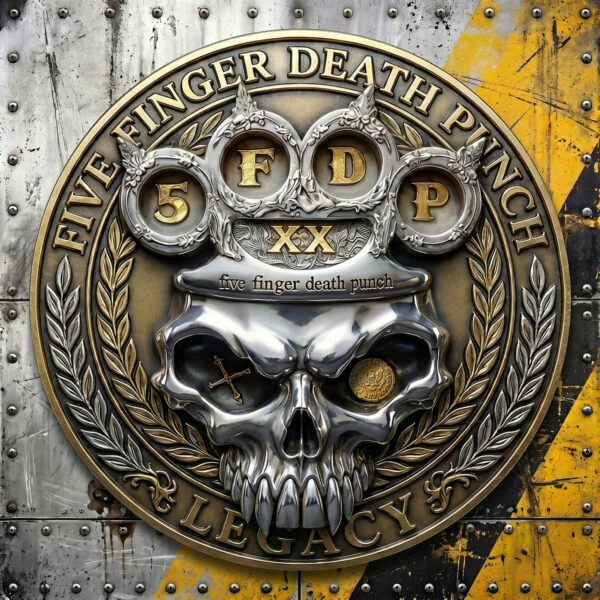
It’s hard to approach AfterLife without thinking about the absence of the historic guitarist, recently replaced by a newcomer. This personnel change doesn’t upset the formula though: Five Finger Death Punch remains faithful to its recipe, the one that has made its fortune for over a decade. Thick riffs, choruses built for stadiums, alternation between clean singing and the frontman’s raw growls: it’s all there, meticulously crafted, polished, almost too predictable to surprise anyone who knows the band inside out.
The signature track as calling card
The eponymous track, released as a single before the album, sums up the exercise well: a calculated buildup, a chorus that hooks from the first listen, polished production signed by the usual team. You can feel the know-how, the technical mastery of a band that knows exactly where it wants to take its audience. But this science of efficiency ends up going in circles: the growls always arrive at the right moment, the melodic bridges follow an identical pattern from one track to another, and the attentive listener can guess the structure before it even unfolds.
IOU and the mechanics of choruses
On IOU, another track pushed to promote the record, we find this tension between dark verses and luminous chorus that has long been the band’s signature. The new guitarist does his job honorably, bringing undeniable technical precision, but without really imposing a new personality on the band’s sound. The solos remain functional, well-executed, without taking risks that would disturb the balance already established by Kevin Churko’s production. We’re in absolute continuity, for better or worse.
Comfort as horizon
That’s where the real problem lies: AfterLife never tries to shake things up. The band seems to have found its commercial comfort zone and is settling in for the long haul, even if it means sacrificing any element of surprise. The ballads, always present in the Five Finger Death Punch equation, fill their function of breathing space between two assaults of heavy riffs, but they sound like faithful copies of those that preceded them on previous albums. You search in vain for a moment that would deviate from the trajectory traced for years, a track that would dare to step outside the well-oiled framework of radio-friendly groove metal.
Ultimately, AfterLife confirms what many suspected: Five Finger Death Punch has found a formula that works and has no intention of deviating from it, even with a guitarist change meant to inject some fresh blood. The efficiency remains intact, the production flawless, the choruses devastatingly catchy for those who enjoy this register. But the overall album sorely lacks rough edges, those moments that leave a lasting mark on a discography. It’s a record that fulfills its contract without ever exceeding it, aimed primarily at already convinced fans rather than those seeking artistic evolution. An album that’s easy enough to listen to without displeasing, but that’s forgotten almost as quickly as it ends, lacking any truly personal imprint.