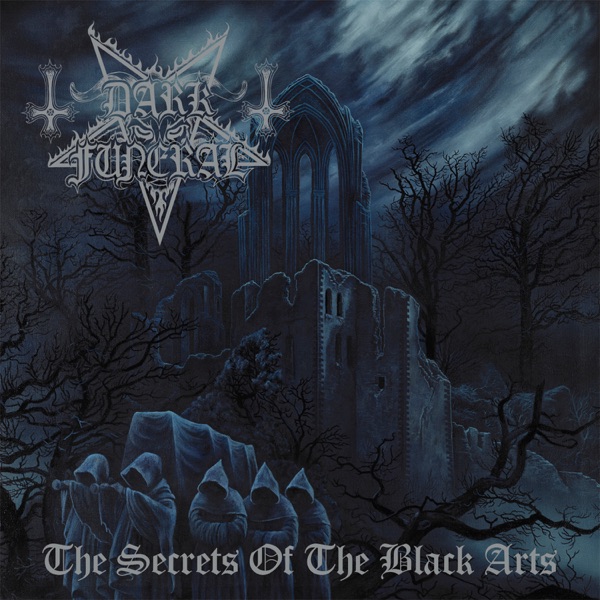
Dark Funeral’s debut full-length, Secrets of the Black Arts, arrived in 1996 as a burst of undiluted velocity inside a Swedish scene already thick with talent. Founded by Lord Ahriman and Blackmoon (David Parland), the Stockholm outfit carved out a vision of black metal stripped of folk or pagan atmosphere. No mournful keyboards, no forest mist: everything is frontal assault, relentless blasting and frostbitten tremolo. The record stakes a claim to frontal Satanic orthodoxy, an intent that lands like a manifesto.
Speed raised to a creed
The record’s signature is its refusal to breathe. Within seconds the drums hammer blast beats at a dizzying tempo while the guitars stack tremolo riffs that trace genuinely malevolent melodies rather than mere walls of noise. Cuts like The Dark Age Has Arrived, My Dark Desires and The Secrets of the Black Arts prove the formula: maximum speed, yet guitar lines you can always follow, even commit to memory.
Unlike the more atmospheric Norwegian black metal of the same period, Dark Funeral aim for pure aggression and immediate impact. The band never tries to lull or bewitch through slowness: it attacks, again and again, in a logic of permanent onslaught that owes as much to Bathory as to the young Stockholm underground led by Dissection and their peers.
A contested but razor-sharp production
The recording history was turbulent. The initial sessions were partly reworked, and the final mix ran through Peter Tagtgren’s Abyss Studio. The result sounds cold and cutting, guitars like a blade, drums clearly pushed forward. That clarity, unusual for the genre at the time, serves the band’s aim perfectly: every note of hatred should be heard, nothing lost in lo-fi mud.
It is also what sets the record apart from the many deliberately grimy productions of the first wave. Dark Funeral embrace a form of professionalism within the extreme, a precision of execution that would become a hallmark of orthodox Swedish black metal.
A foundational marker
With this album Dark Funeral laid the groundwork for what would be called orthodox Swedish black metal, a school devoted to explicit blasphemy and technical intensity. The influence would later surface in Marduk, Setherial and a whole generation of bands dedicated to the cult of speed. You can fault the record for a certain sameness over its length, short on true dynamic nuance, but its historical weight is undeniable.
Three decades on, Secrets of the Black Arts stands as a manifesto: a black metal that chooses surgical brutality as a form of purity. A nervy, imperfect, yet essential classic for anyone tracing the genre’s most radical and uncompromising wing. Rating: 8.