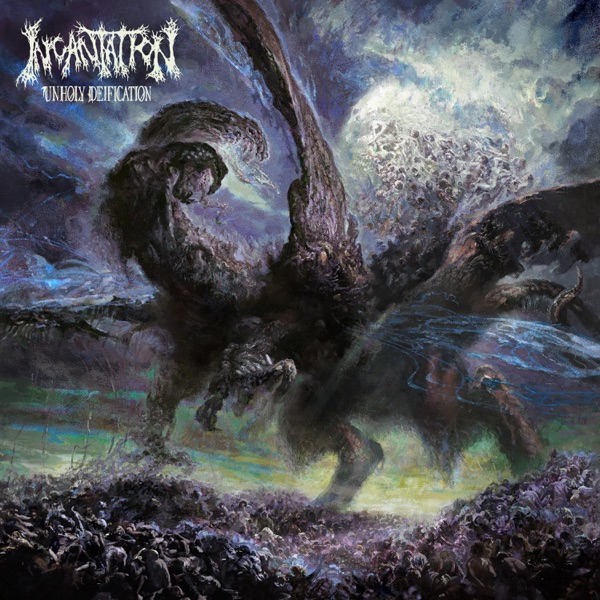
Profane Nexus marks Incantation’s return to Relapse Records, a label they hadn’t worked with since The Infernal Storm. This simple editorial fact alone gives the listening experience a particular character: you sense a band carefully orchestrating their return under the spotlight of a larger structure, without renouncing the grit that built their reputation. Recorded in their own studios in Johnstown, Pennsylvania, the album retains that artisanal, almost clandestine texture that has defined the group since its inception.
A cave that still breathes
The mixing and mastering by Dan Swanö bring an unusual clarity to this kind of production, without ever sacrificing the suffocating aspect that defines Incantation’s sound. The guitars remain tuned extremely low, the riffs crawl rather than strike, and the drums alternate between crisp blasts and slowdowns that evoke the most funereal doom. You find that alternation of speed and slowness that has always been the band’s signature, but it seems better calibrated here, as if years of practice had sharpened the formation’s instinct for knowing when to suffocate the listener and when to let them breathe for a moment before plunging them back in.
Vocals as inverted liturgy
The voice, forever guttural and cavernous, functions less as a melodic element than as an additional texture in this sonic magma. It blends into the riffs, sometimes disappears beneath the guitar mass, then resurfaces the moment the song shifts toward a slower, heavier passage. This way of treating the vocals as an instrument among others, rather than as a frontal element, reinforces the impression of a collective ritual rather than an individual performance. The most successful tracks are those where this alchemy between riff, voice and rhythm reaches a combustion point, where you can barely distinguish the components as they interweave.
Between loyalty and weariness
The main flaw of Profane Nexus lies in its very structure: the band applies a formula they’ve mastered perfectly, but which eventually reveals its limits over the album’s duration. The middle tracks sometimes lack the distinct identity that set apart the best moments of their oldest classics, and the listener may sense a certain monotony past the first third of the record. It’s not an execution problem; the band plays with ruthless precision, but rather a lack of risk-taking that could have turned a good record into a great one. You sense veterans who know their terrain by heart, to the point of sometimes settling comfortably into it rather than digging deeper.
Still, Profane Nexus holds its place in the band’s discography as a solid, coherent piece that never betrays the original spirit of the formation. Those seeking a sonic revolution will move on, but those wanting to rediscover that suffocating atmosphere and old-school songwriting that built Incantation’s reputation will find plenty to satisfy them here. It’s not the album through which to discover the band, but it’s an honest confirmation of their ability to remain true to themselves without sliding into pure repetition. An album for the convinced, not for converting the skeptics.