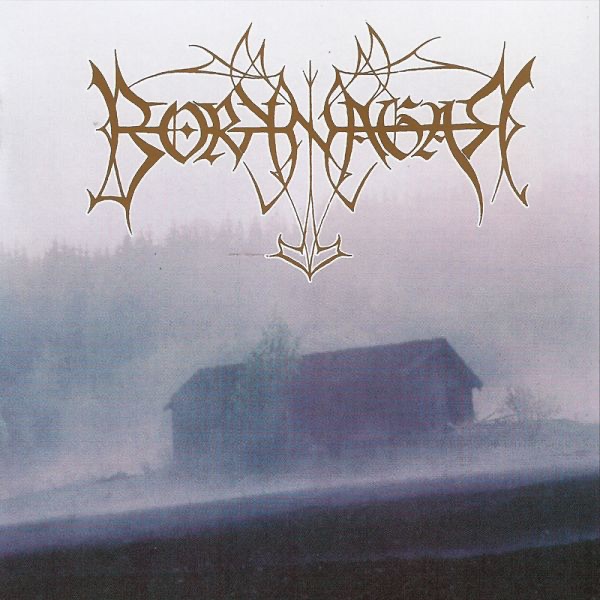
Borknagar’s second album, The Olden Domain (1997), confirms the ambition of the project founded by guitarist Oystein Garnes Brun: to wed black metal’s fury to a progressive, epic dimension. Far from the raw minimalism of the first wave, the Norwegian band embraces here a wealth of arrangement and a reach for grandeur that sets it clearly apart from its peers. It is a record turned toward the horizon, toward summits and wide-open spaces, where nature is no mere backdrop but an almost spiritual force running through every track.
An open, ambitious black metal
From the first listen you sense a will to move beyond the genre’s strict codes. Structures grow more complex, keyboards add atmospheric layers, and the guitars alternate furious tremolo with more open passages. The album evokes Nordic paganism and untamed nature as much as inner turmoil, in an almost philosophical approach that widens black metal’s usual thematic range.
This is also the record that brings in vocalist Simen Hestnaes (ICS Vortex), whose voice, able to move from shriek to powerful clean singing, greatly widens the band’s expressive palette. That vocal duality becomes one of Borknagar’s main assets, a contrast that gives depth to every composition.
Grandeur as a horizon
What strikes most is the sense of space: the compositions breathe, stretch out, reach for flight rather than suffocation. Borknagar does not disown aggression but puts it in service of a panoramic, almost cinematic vision. Memorable melodies and rhythmic shifts testify to careful writing, where each track charts a progression rather than repeating a motif.
Without yet reaching the perfect maturity of its later albums, the band here lays the foundations of its progressive identity. You sense a group in full creative ferment, gathering musicians drawn from varied corners of the Norwegian scene, among them the keyboardist tied to Enslaved.
An essential link
In the late-1990s black metal landscape, The Olden Domain holds a particular place: that of the bands who refused to lock themselves into orthodoxy and explored wider territory. You can fault it for a few stretches that drag and a production that has aged somewhat, less powerful than that of the records that followed, but its inventiveness remains stimulating and its sweep intact.
It is a marker of the Norwegian progressive scene, a door opened toward what the genre could become when it dared to dream bigger. For anyone seeking to understand how black metal managed to reinvent itself without betraying its roots, this record is essential listening. It also foreshadows the trajectory of a band that, through the years and its shifting line-ups, would make exploration its trademark. Heard today, The Olden Domain keeps a sweep and a sincerity that more than offset its minor flaws. Rating: 8.