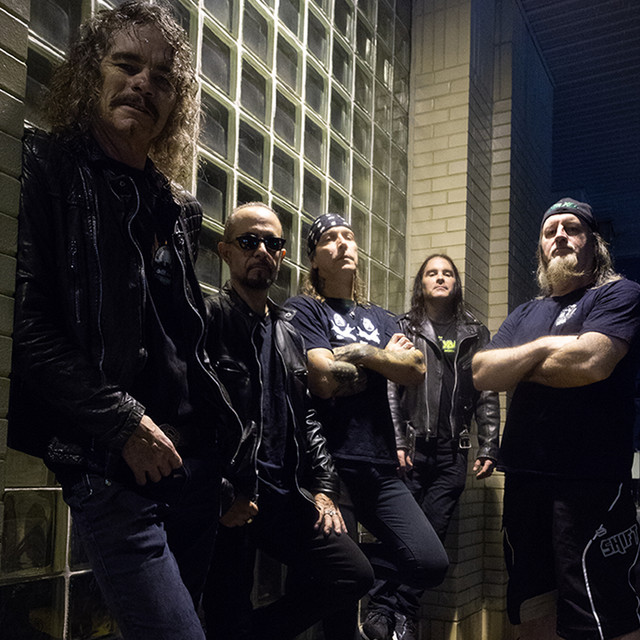
Overkill never needed to reinvent itself to prove it still had something left in the tank, but Scorched arrives after the group’s longest gap between records, and that wait can be felt in the album’s density. The vocalist still attacks with that raspy timbre, half-scream half-sneer, that has been his trademark since the beginning, and the bassist continues weaving mobile lines beneath riffs that prioritize mass over pure speed. We are far from the thrash sprint of the eighties: here, the group embraces a medium tempo, heavier, more patient, without ever succumbing to self-indulgent sluggishness.
A riff that takes its time
The opening track, Scorched, sets the tone: a gradual buildup, almost menacing, before the drums come crashing down hard and square. The drummer, signing off here with his final appearance on a studio album with the group, imposes precise playing, free of unnecessary flourishes, that lets the riffs breathe rather than suffocate them under constant double bass pedals. It’s an approach that serves D.D. Verni’s songwriting well, oriented more toward heavy groove than technical excess. The choruses, often chanted rather than sung, function as easily memorable anchor points, sometimes at the cost of a certain predictability in the song structures.
The East Coast stamp, intact
What strikes you on listening is the coherence of the whole. Overkill isn’t seeking to surprise, it’s seeking to confirm, and by that logic, Scorched works as a synthesis of what the group has known how to do best since the comeback that began several albums ago: grainy guitars, a thick production sound without being saturated, and that bouncy rhythm section inherited from punk that has always distinguished the group from its California peers. The faster tracks, when they arrive, remind us that the original nervousness hasn’t completely disappeared, it simply becomes rarer, more calculated.
The limits of a proven formula
The flip side of this solidity is a certain lack of risk-taking. Past the shock of the opening tracks, the album settles into a format where songs respond to each other without always standing out clearly from one another. You sense a group in complete command of its language, but no longer seeking to shake it up from within. Die-hard fans will happily rediscover the familiar writing quirks: the chorus rebounds, the suspended breaks before a forceful return, the vocalist’s ad-libs punctuating the ends of phrases. Others might find the album a bit drawn-out in length, though it’s never unpleasant to listen to.
Scorched is neither a lazy rehash nor an unexpected masterpiece: it’s a record from veterans who know exactly what they need to deliver and deliver it seriously, without flash or obvious commercial calculation. You hear a group tired of nothing, always solid on its foundations, closing this chapter of its existence with an honorable rather than historic record. Neither the peak of their discography nor a misstep, Scorched positions itself as a reliable piece in an already very coherent body of work, to be prioritized for those who never left the ship.