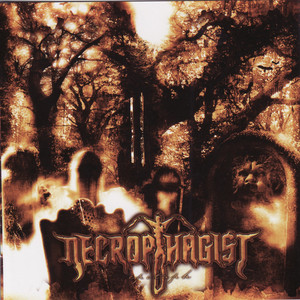
Nine years after Onset of Putrefaction, Muhammed Suicmez rebuilt Necrophagist around a top-tier lineup and delivered, in 2004, a record that would durably redefine technical death metal. Epitaph is more than a showcase for virtuosos: it is a cold, methodical demonstration of how far the genre can reach when composition wins out over mere display. The German act distils years of work into eight tracks of formidable precision. Nothing is left to chance here. The technicality here always stays in the service of feeling, never the reverse.
An architecture of precision
Everything here breathes control. Riffs succeed one another with almost mathematical logic, tempo shifts land to the millimetre, and Stephan Fimmers’ fretless bass converses with the guitars rather than simply doubling the rhythm line. Drummer Hannes Grossmann brings rare legibility: his blasts and fills stay audible and structural, never buried in the mix.
On tracks like Stabwound or Ignominious and Pale, Suicmez piles up swept arpeggios and neoclassical phrasing without ever slipping into pure exercise. Every solo says something, every passage serves the whole piece. You feel the legacy of classical guitar and shred, yet always bent to the demands of death metal composition. Behind every transition you sense patient, goldsmith-like work.
The Suicmez signature
The deep, perfectly articulated guttural vocal cuts against the instrumental finesse and creates the contrast that became the band’s trademark. The production, clean and defined, lets each instrument breathe: you hear the grain of the strings, the dry snap of the kit, the smallest note in a rapid legato run. Nothing is left to chance.
That clarity is what sets Epitaph apart from the mass of saturated technical records: complexity here does not exist to impress, it exists to serve the music. Suicmez thinks like an architect, arranging the parts as interlocking blocks, and the record keeps a rare coherence despite its density. The density of the writing never harms its legibility.
A lasting legacy
It is hard to overstate this album’s influence. A whole generation of technical and progressive death metal bands built themselves around what Necrophagist codified: a blend of brutality, learned melody and formal rigour. The musicians in this lineup went on to shape other significant acts on the scene.
Twenty years on, the absence of a follow-up has only deepened the record’s cult status. It remains a reference that people cite, study and try to match, without many truly succeeding.
Demanding, dense, at times clinical in its perfection, Epitaph asks for attention and rewards it fully. It is a peak of the genre, a record that set a technical and compositional bar many are still aiming at. A modern classic, no argument possible. People still return to it to gauge how far a whole scene has come.