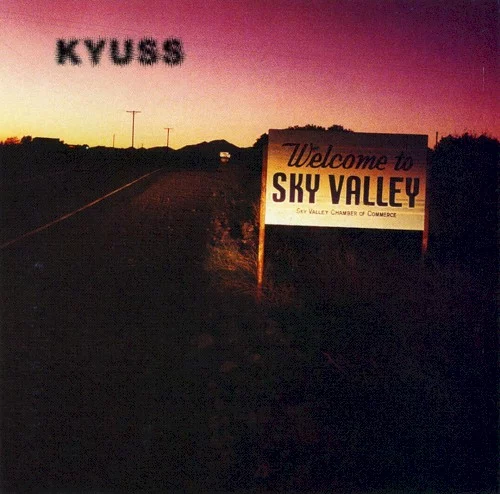
The third album by California’s Kyuss, Welcome to Sky Valley (1994), is often regarded as the cornerstone of desert rock. Born from jam sessions out in the Palm Desert, this record embodies the spirit of a music that is raw, warm and hypnotic, played by a crew of young musicians who would leave a lasting mark on heavy rock and later scatter into countless projects. Far from the big cities and the usual circuits, Kyuss forged themselves at wild desert parties, playing out in the open, powered by generators, and that origin can be felt in every note.
The sound of the desert
Kyuss invented an aesthetic: a rock tuned very low, played partly through bass amps, yielding a thick, vibrating, almost sandy grain. That singular sound evokes the heat, the space and the wandering of Southern California’s arid landscapes. Far from any urban edge, Welcome to Sky Valley breathes open air and freedom, as if the music had soaked up the desert where it was born.
The band gathered remarkable talents, among them guitarist Josh Homme, future founder of Queens of the Stone Age, and singer John Garcia, with his warm, powerful voice. That particular alchemy, made of camaraderie and youth, would never quite recur in exactly the same way.
A structure in movements
Originally conceived as a suite in three movements grouping several songs, the album invites continuous listening, almost like an initiatory journey. Tracks such as Gardenia, Demon Cleaner and Space Cadet alternate massive riffs, psychedelic flights and calmer passages, where tension eases only to surge again.
That fluidity, that refusal of radio formatting, gives the record an organic coherence and a depth rare for its time. You sense a band playing for the sheer joy of it, working in a logic of groove and controlled improvisation rather than calibrated singles.
A founding legacy
Even though Kyuss never enjoyed huge commercial success in their day, their influence is colossal. Welcome to Sky Valley laid the foundations of modern stoner rock and inspired hundreds of bands, from Queens of the Stone Age to the whole desert scene and beyond. The record is now a reference cited by everyone who wields a heavy, groovy riff.
Warm, groovy and hazy, this record remains an absolute reference: proof that heavy rock can also be luminous and breathing, that it can evoke freedom as much as weight. The band’s breakup soon after only added to its legend, turning this peak into the testament of an adventure cut too short. Heard today, it has lost none of its force or freshness, as if the desert had sealed its heat into the vinyl. A timeless classic of the genre, whose magic every listen confirms. Rating: 9.