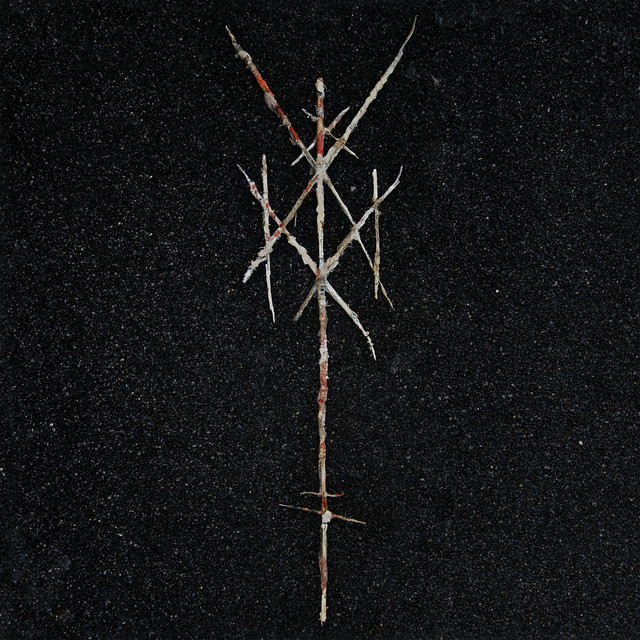
After the De Doden Hebben Het Goed trilogy, which built Wiegedood’s reputation far beyond Ghent’s underground circles, the Belgian group returns with an album bearing an almost prophetic title. There’s Always Blood At The End Of The Road doesn’t seek to mechanically extend the formula that brought them success: instead, it tightens it, deepens it, and extracts something rawer, more mineral from it. We find the familiar structure, uninterrupted tremolos, dry blast beats, vocals screaming in the background, but the sonic matter here feels drier, stripped of complacent reverb.
A road that shows no mercy
From the first minutes, the album imposes a forced march rhythm. The riffs don’t chase obvious melody: they turn inward, coil around themselves, create vertigo that owes much to the near-mathematical repetition of tremolos. The drummer pushes blast beats that never truly release tension, even in passages where the tempo seems to slow. This is black metal that pushes forward head down, without unnecessary ornament, drawing its strength from this frontal advance rather than compositional surprises.
Hypnosis as engine
What sets Wiegedood apart from much of the scene is this ability to transform repetition into trance rather than tedium. The tracks on this album play with guitar loops that evolve through micro-shifts, almost imperceptible, until you realize the landscape has completely changed without any clean rupture. This approach demands patience from the listener: there’s no chorus to remember, no moment calibrated for the pit. We’re closer to an altered state, a mental undertow, than a concert of raised fists. The production, rawer than on previous records, accentuates this sensation of permanent friction, as if each guitar were scraping against the next.
The price of radicalism
This uncompromising stance has a downside: the album makes no concessions to the impatient listener. The tracks follow one another without much textural contrast, and you have to accept being swept up by the duration for the machinery to fully operate. Those seeking melodic breakthroughs or more pronounced atmospheric breathing spaces, as could occasionally be found in the previous trilogy, risk finding the album monolithic, almost austere. But it’s precisely this uncompromising quality that gives the album its coherence: Wiegedood doesn’t seek to seduce, it seeks to immerse, and it succeeds with a discipline that commands respect, even when it wears on the nerves.
There’s Always Blood At The End Of The Road confirms that Wiegedood doesn’t need to reinvent its language to remain relevant: it just needs to push it further to its limits, honing angles down to the bone. The album won’t revolutionize the genre, but it refines an already solid identity, and does so with an intensity that never truly falters over its duration. This is a demanding record, crafted for continuous listening rather than isolated tracks, and one that confirms the band’s place among the most reliable formations on today’s extreme European scene.