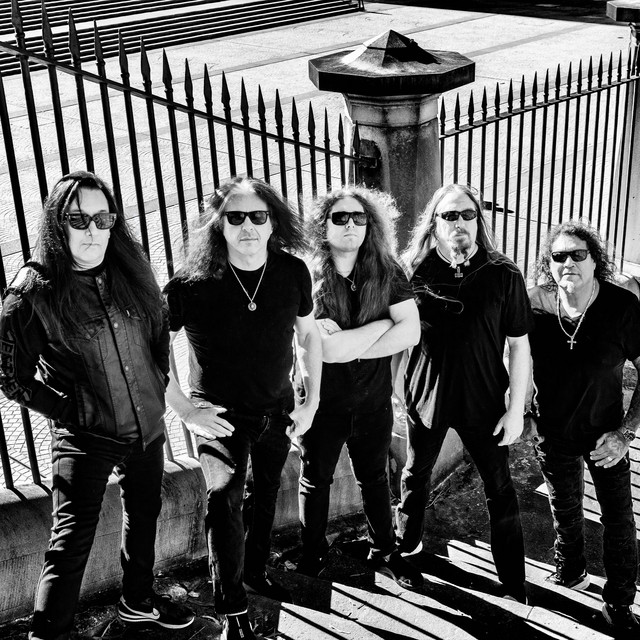
Testament’s first album, The Legacy (1987), is one of the great debuts of the San Francisco Bay Area thrash scene. Arriving after the genre’s pioneers, the band nonetheless asserts itself at once through a rare blend of speed, technique and melody, carried by the playing of guitarist Alex Skolnick. Formed in the same region as Metallica and Exodus, the band drew on the ferment of a booming scene, yet set itself apart with a melodic elegance that already hinted at the more progressive turns of its later discography.
Virtuosity in service of the riff
What sets Testament apart immediately is the contrast between Eric Peterson’s rhythmic power and Skolnick’s neoclassical solos. Where many thrash bands bet on chaos, Skolnick brings a melodic elegance, constructed, almost lyrical phrases that give the record a particular color without ever blunting its aggression.
On vocals, Chuck Billy, who joined shortly before recording after Steve Souza left for Exodus, already brings a solid presence, poised between howl and melody. The rhythm section holds the pace with assurance, leaving the guitars room to shine. This marriage of power and finesse would become the band’s signature, and it partly explains why Testament could evolve where other thrash acts stayed prisoners of a single formula. From the outset, variety was written into its DNA.
Tracks that leave a mark
Over the Wall opens the album at full tilt and remains one of the band’s most-played songs live. Burnt Offerings unfolds a darker mood, The Haunting works the dynamics, and First Strike Is Deadly sums up the record’s thrash efficiency. The whole holds up from end to end, with no filler.
The production, by Alex Perialas, may sound less massive than the band’s later records, but it captures well that energy of a young act with everything to prove.
A solid base for a long career
The Legacy may not have had the immediate commercial impact of some of its contemporaries, but it established Testament as one of the most gifted bands of the second thrash wave. Many still regard it as one of their finest records, the one where everything was already in place.
Our score of 8 salutes an accomplished debut, more technical and melodic than the genre average, that launched a long and respected career. An ideal starting point for anyone wanting to understand why Testament lasted where so many others vanished. Heard in hindsight, The Legacy sounds like the kept promise of a band that, far from merely imitating its elders, was already seeking its own voice. It is a generous record, played with the hunger of the early days and an already remarkable technical assurance.