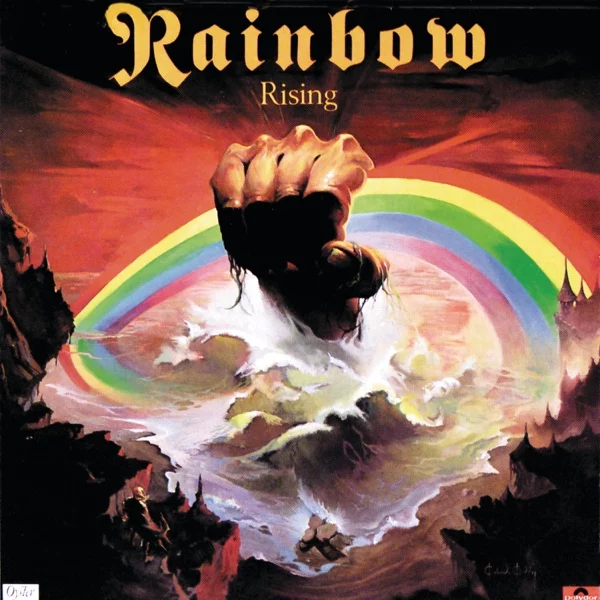
Released in 1976, Rising is the second album by Rainbow, the band led by guitarist Ritchie Blackmore after his departure from Deep Purple. Gathered around singer Ronnie James Dio and drummer Cozy Powell, the group delivers a short but dense record, often regarded as one of the peaks of 1970s hard rock and a matrix for the metal to come.
A concise masterpiece
Rising has only six tracks, yet each imposes its presence. The first side lines up nervous tracks such as Tarot Woman, carried by a keyboard introduction, and Do You Close Your Eyes, more direct and rocking.
Ronnie James Dio’s powerful, melodic voice finds an ideal setting here, while Cozy Powell’s massive drumming gives the whole an impressive foundation. The rapport between these musicians shows at every moment.
Two legendary epics
The second side of the album is dominated by two long pieces that became cult favourites. Stargazer, with its Eastern flavoured riff and ample orchestration, tells the mad dream of a wizard seeking to rise toward the stars, and remains one of the peaks of the repertoire.
A Light in the Black follows at a frantic tempo, giving free rein to the solos of Blackmore and keyboardist Tony Carey. These two ambitious, theatrical tracks deeply influenced epic hard rock and the metal to come.
A considerable influence
Rising laid the foundations of a heavy, melodic and grandiose rock that would inspire generations of musicians, from traditional heavy metal to power metal. The alliance of Dio’s singing, Blackmore’s guitar and Powell’s drumming reaches a rare degree of osmosis here.
The period production may feel a little dated and the album’s brevity will frustrate some. But the intensity and inventiveness of these six tracks amply make up for it. To understand the roots of melodic and epic metal, Rising remains essential listening and a timeless classic.