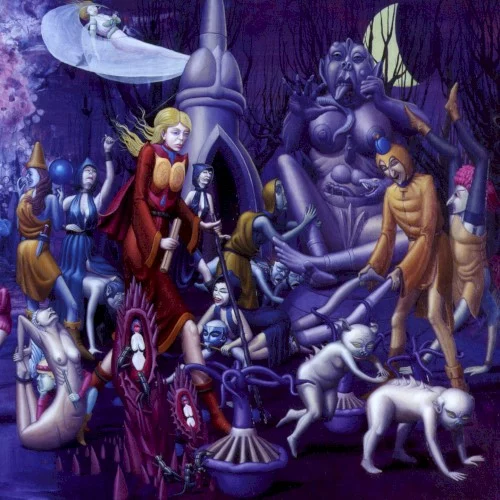
Closing the loop is never easy, especially when you’ve spent part of your career running from what gave you birth. Cathedral, which had long toyed with psychedelic groove and seventies hard rock undertones, chooses for its final record to return to basics: the funereal slowness and suffocating heaviness of its earliest days. The Last Spire closes the band’s discography while also shutting a parenthesis opened with Forest of Equilibrium, as if everything else had been nothing but a necessary detour before coming back home.
An Assumed Epitaph
From the opening moments, the intention is crystal clear: there is no longer any question of entertaining, but of burying things with dignity. The riffs stretch out with an almost ceremonial slowness, the guitar drags notes as heavy as tombstones, and the singer’s voice, grave and incantatory, abandons its rockier flights to rediscover an inhabited gravity. You sense a band no longer trying to prove anything, but closing a narrative with a kind of disabused serenity. This is not an album of easy nostalgia; it’s an album of organized mourning.
The Weight of Silence
What strikes you is the way the songs let emptiness breathe. Transitions are rare, brutal breaks even rarer, and it’s precisely this absence of flourishes that gives the album its oppressive character. The raw, artifact-free production reinforces this sensation of listening suspended in a closed space, almost a crypt. The riffs don’t seek immediate impact: they impose themselves through repetition, through dull hammering, through a rhythm that advances like a funeral procession rather than a rock pulse. This is far from the carnival flourishes of other periods in the band’s history, and that’s precisely what gives this final chapter its strength.
The Return to Origins as the Final Point
There’s something coherent, almost logical, about seeing a band founded in rebellion against speed and aggression choose to end its journey by returning to that extreme slowness which defined it in its early days. The Last Spire doesn’t try to summarize the entire band’s career: it chooses one facet, the darkest, the most massive, and locks itself into it with absolute discipline. Fans of their groovier records may regret the absence of those more upbeat detours, but this radical choice gives the album its own identity, unlike any other milestone in their discography.
Ultimately, The Last Spire is a rare success: a final album that sounds neither like a tired last stand nor a commercial rehash, but like a fully mastered artistic gesture. The band chooses to leave by digging its own grave with care, riff after riff, without looking back. It’s heavy, it’s long, it’s sometimes difficult to access for those seeking immediate energy, but it possesses a coherence and intensity that command respect. Few bands know how to organize their own disappearance with such sonic dignity. Cathedral manages it, and closes its story on one of its most inhabited albums.